Inspecting Pre-Assembled Cabinets on Delivery
The freight bill is a legal document, and signing it clean usually ends the carrier's responsibility for what is inside the cartons. That makes the twenty minutes before the signature the most valuable part of the whole purchase. CasaBuilt publishes free shipping at $2,500, a one-year warranty against manufacturing defects, and a specification detailed enough to check a delivered cabinet against paper before the truck leaves.

Key takeaways
- Sign only after the carton count matches the packing list and the outer packaging is photographed.
- Note damage on the bill itself, in writing, before the driver leaves.
- The published box is 1/2-inch birch plywood with a 3/4-inch solid birch face frame, so a crushed corner is visible immediately.
- Free shipping starts at $2,500; a replacement order below that line pays freight again.
Signing is the moment risk moves
Freight damage falls into two categories, and they are handled very differently. Visible damage is a conversation you have while the driver is still standing there. Concealed damage is a conversation you have three days later with a claims department that has a clean signature on file. The difference between the two is a pen stroke.
That is why the inspection should start before the truck is unloaded. Walk the trailer, count the cartons against the packing list, and look at the corners. Cabinets travel as flat-pack or built boxes, and the corners take the load when a pallet is strapped too tight or a forklift clips a stack. A crushed corner on a built cabinet usually means a damaged door or a racked box, and both are easier to prove before the carton goes inside.
If something is wrong, write it on the delivery receipt. Not "subject to inspection" as a hopeful catch-all, but a specific note: two cartons crushed on the right-hand corner, door panel visible through the wrap. Photograph the carton, the label and the damage in the same frame. Then sign. A specific note gives the replacement conversation a starting point; a clean signature gives it an ending.
Count first, open second
The packing list is the only document that tells you what should be on the truck. Count cartons before you open any of them, because a missing carton discovered after the truck leaves becomes a delivery dispute rather than a loading error. The count should match the order line for line, including the small items: hinges, glides, filler strips and the hardware bag that ships with flat-pack kits. Built units travel in fewer, heavier cartons, so a short shipment of pre assembled cabinets is easy to spot at the tailgate and much harder to argue about a week later.
Then open one carton of each type rather than every carton. You are looking for three things: the finish, the panel edges and the door alignment. Hold the door up to daylight at an angle. Painted finishes show a run or a thin edge where the spray gun missed, and a white door that reads slightly grey next to another white door is a batch problem rather than a lighting problem.
This is where a sample door earns its $9.99. CasaBuilt keeps 16 sample doors in stock at $9.99 each, refundable against a cabinet purchase, so the color you approved in your own kitchen at 7am is the reference the delivered door has to match. If the delivered finish is visibly different from the sample, that is a defect claim with evidence attached, not an opinion about tone. You can order the sample doors before the main order and keep one in the drawer as a reference.
What to check on the cabinet itself
Once the carton is open, the published specification becomes a checklist. You are not judging taste. You are confirming that the product matches the page you bought from, because a substitution discovered later is much harder to argue.
| Part | Published figure | What a fault looks like |
|---|---|---|
| Box side | 1/2-inch birch plywood | Delamination at the cut edge, soft or crumbling core |
| Face frame | 3/4-inch by 1-1/2-inch solid birch | Split at a joint, filler that does not sit flush |
| Drawer side | 5/8-inch rubberwood, dovetail | Loose dovetail pins, drawer that racks when pulled |
| Shelf | 3/4-inch plywood, adjustable | Warp across the span, pins that do not seat |
| Hinges | Soft-close, concealed, 6-way adjustable | Door that will not sit flush after adjustment |
| Drawer glides | Soft-close undermount, full extension | Glide that binds before the drawer is fully out |
| Base cabinet | 34-1/2 inches high by 24 inches deep | Out-of-square box, more than a slight twist |
| Wall cabinet | 12 inches deep | Back panel separated from the sides |
Two checks catch most of the rest. Open and close every door and drawer once, listening for the soft-close mechanism. Then measure the box diagonally, corner to corner, on any cabinet that looks off. A box that is out of square by more than a small amount will fight you at installation, and it is a manufacturing fault rather than an installation error.
The small-order trap after a claim
A replacement door is a small order, and small orders have their own economics. CasaBuilt ships free on orders of $2,500 or more, which means a single replacement part almost always pays freight. That is not a reason to skip the inspection and hope; it is a reason to get the claim right the first time and to list every damaged item in one claim rather than three.
It also changes how you should read your original order. A $900 order and a $1,700 order each pay freight, and the only thing between them and free shipping is the total on the day. Combining two rooms into one order is often cheaper than two deliveries, even when the second room is not ready yet, because cabinets store flat and dry in a garage far more cheaply than freight costs twice.
The warranty covers manufacturing defects in materials and workmanship for one year under normal residential use. Freight damage is a different claim, handled through the delivery paperwork, which is why the note on the bill matters more than the warranty for anything that arrived broken.
Worked example
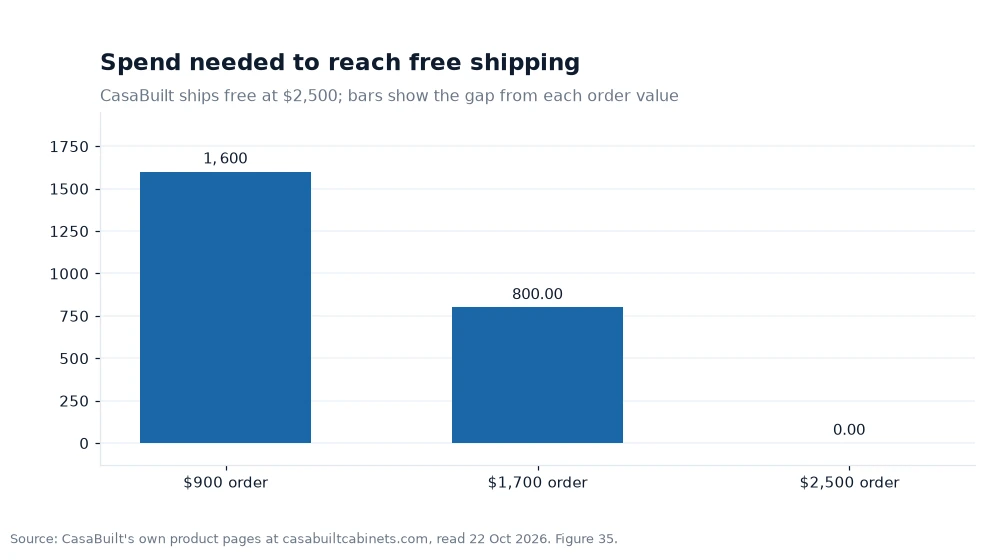
The chart measures the distance from three order values to the published $2,500 free-shipping threshold. At $900, the gap is $2,500 minus $900, or $1,600. At $1,700, the gap is $2,500 minus $1,700, or $800. At $2,500 the gap is $2,500 minus $2,500, or $0.
The useful comparison is the top two bars. A $900 order needs $1,600 more to qualify, which is 178% of its own value ($1,600 divided by $900). A $1,700 order needs $800 more, which is 47% of its value ($800 divided by $1,700). The larger order is closer to the threshold in both absolute and relative terms, even though both are short of it.
Now combine the two. $900 plus $1,700 is $2,600, which clears $2,500 by $100 and turns two paid freight bills into one free delivery. If the second room is three weeks away, the choice is $100 of cabinets sitting in a garage against a second freight charge on a $1,700 order. That is the arithmetic behind the advice to consolidate, and it applies just as well to a replacement claim: list every damaged piece at once.
Frequently asked questions
Should I refuse a damaged delivery?
Refusing the whole shipment is rarely the best first move, because the undamaged cabinets are still needed. Note the specific damage on the delivery receipt, photograph the carton and the label, accept the shipment and open a claim for the affected pieces. A written note made before signing is what protects the claim.
How long do I have to report concealed damage?
The published site does not set a concealed-damage window, so the practical answer is to report it the same day and to inspect before signing wherever possible. The one-year warranty covers manufacturing defects in materials and workmanship under normal residential use, which is a separate route from freight damage.
Do I need to assemble anything to inspect it?
No. Assembled cabinets arrive built, so the box, doors, drawers and hinges can all be checked as delivered. For flat-pack RTA cabinets, check the panels and hardware against the packing list first, because a missing cam or hinge is easier to resolve before assembly begins than after.
Photograph, annotate, then sign
Keep a routine and the routine will carry you when the driver is in a hurry. Count cartons against the list, photograph the stack, open one of each type, work the checklist and write any fault on the bill in plain words. Then sign and move the cartons somewhere dry and flat.
The inspection costs twenty minutes and protects a purchase worth thousands. The alternative is a clean signature and a claim that depends on how persuasive you sound on the phone three days later.
Figures quoted here come from the manufacturer's own website, read 22 Oct 2026[1].