Cider and Kombucha Lines Alongside Beer
A brewery that adds cider and kombucha is not buying three plants; it is buying one brewhouse and three fermentation calendars. HGMC publishes fermentation tanks for beer, kombucha and cider duties in the same product family, which makes the vessels the easy part and the scheduling the hard part.
Key takeaways
- The published product families cover beer, wine and cider, and kombucha, with fermentation tanks listed for beer, kombucha, cider, conical and wine duties.
- Capacity runs from 100 L to 200 T, with micro craft systems at 1,000-3,000 L and a microbrewery class published as 18,000 barrels a year or less.
- Budget a full cleaning cycle at every product change: two changeovers a week add about five hours to a 40-hour brewhouse week in the worked plan below.
- Kombucha is usually kept on a dedicated tank set, because the acetic culture will find anything a cleaning cycle misses.
What the Catalogue Already Contains
The published Brewing Equipment range covers more than beer, which is the detail that makes a multi-product plan realistic. Fermentation tanks are published for beer, kombucha, cider, conical and wine duties; filling machines are published for bottles and cans; and the wider catalogue includes a CIP system, a beer tunnel pasteuriser, CO2 recovery plant, wet milling, malting and distillery equipment.
Read that list as three groups. The shared group is everything that handles liquid and heat: vessels, pumps, plate heat exchangers, glycol, CIP. The product-specific group is filtration, pasteurisation and packaging, where cider and kombucha diverge from beer. The optional group is the revenue side — malting, distillery work and CO2 recovery — which most start-ups add in year three rather than year one.
Shared Vessels, Separate Fermentation Plans
The same conical tank can hold an ale, a cider or a kombucha, because the vessel requirement is largely the same: food-grade stainless, a cooling jacket, a cone to collect solids and a sanitary fitting set. What differs is the calendar. An ale at 14 days, a cider at three weeks with a long cold conditioning, and a kombucha at about ten days occupy the same steel for very different lengths of time, and a tank farm sized for beer alone will not carry all three.
This is where a two-product or three-product plan earns its keep: mixing residency lengths smooths the brewhouse load. If the ale tanks are full but the schedule has a free brew day, that day belongs to whichever product is legal for the vessels available, and the published range from a nano class at 5 BBL or less to a 200 T plant means the same supplier can extend the tank farm a step at a time rather than replacing it.
Where Cider and Kombucha Diverge From Beer
Cider is a slow, cold, patient process that shares beer's equipment but not its urgency. It ferments cool, it wants time on the lees or in the tank, and it usually wants a drier, more aromatic finish than beer drinkers expect. The practical consequence for a brewery is tank time: a cider occupying a tank for three weeks costs three times the schedule space of a ten-day kombucha, so the tank count has to be planned per product rather than as a total.
Kombucha is the opposite problem. It is quick, it is warm-fermented, and it carries an acetic culture that most brewers do not want anywhere near a beer tank. The published catalogue lists kombucha fermentation tanks as a separate product family, and the sensible reading is that they are the same construction with a different life. Producers who run both usually keep a dedicated set, because acetic acid bacteria will find the one gasket a cleaning cycle misses.
Sizing the Room for Three Products
Start from the size class rather than the product. The published micro craft band of 1,000-3,000 L is wide enough for a brewery that also wants a cider and a kombucha line, because the brewhouse is shared and only the fermentation and packaging equipment is duplicated. Below that band, a nano class of 5 BBL or less is a single-product plant in practice; above it, large commercial plant up to 100 HL is a different business model with a sales force.
The room is the second constraint after the class. Three products need three sets of hoses, three cleaning regimes, a segregated cold room for kombucha, and enough tank floor to hold each product's residency. A brewer who plans the brewhouse for one product and the tank floor for three will run out of the second long before the first, which is why the tank count — not the kettle size — is the number to argue about.
| Product line | Vessel or machine published for it | Share with beer? | Practical watch-out |
|---|---|---|---|
| Beer | Fermentation tanks, brewhouse, CIP, can and bottle fillers | It is the base plant | Residency of about 14 days sets the tank count for the whole site |
| Cider | Cider brewing equipment and fermentation tanks | Yes, the same conical tanks | Longer tank time: about three weeks of residency per batch |
| Kombucha | Kombucha brewing equipment and fermentation tanks | Same construction, usually a dedicated set | The acetic culture survives in anything cleaning misses |
| Packaging and finishing | Beer filling machines for bottles and cans, tunnel pasteuriser | Partly, if the format matches | Cider and kombucha carbonation and pasteurisation needs differ from beer |
| Cleaning | CIP system | Yes, with a changeover cycle per product | Every product change costs a full cleaning cycle of brewhouse time |
Worked example
The plan below is a worked example for one assumed brewhouse, not a recommendation. Assumptions: a 1,000 L brewhouse, three beer brews a week at 14 days of residency, one cider brew a week at 21 days, one kombucha brew a week at 10 days, a six-hour brewhouse day per brew and a 2.5-hour cleaning cycle at each product change.
Tank arithmetic first, using tanks divided by residency in days multiplied by seven. Beer: 3 x 14 / 7 = 6 tanks. Cider: 1 x 21 / 7 = 3 tanks. Kombucha: 1 x 10 / 7 = 1.4, which rounds up to 2 tanks. Total: 6 + 3 + 2 = 11 tanks at 1,000 L each, or 11,000 L of fermentation capacity feeding a 1,000 L kettle. The kettle is small next to the tank farm, and that is normal for a three-product site.
Kettle time next. Five brews a week at six hours each is 30 hours, and two product changeovers at 2.5 hours add 5 hours, giving 35 hours of a nominal 40-hour week. That leaves five hours for maintenance, a delivery, or a batch that runs long — a thin margin. At the published micro craft ceiling of 3,000 L the same schedule occupies identical hours for three times the volume, which is why the upper end of the band is where multi-product plants usually start.
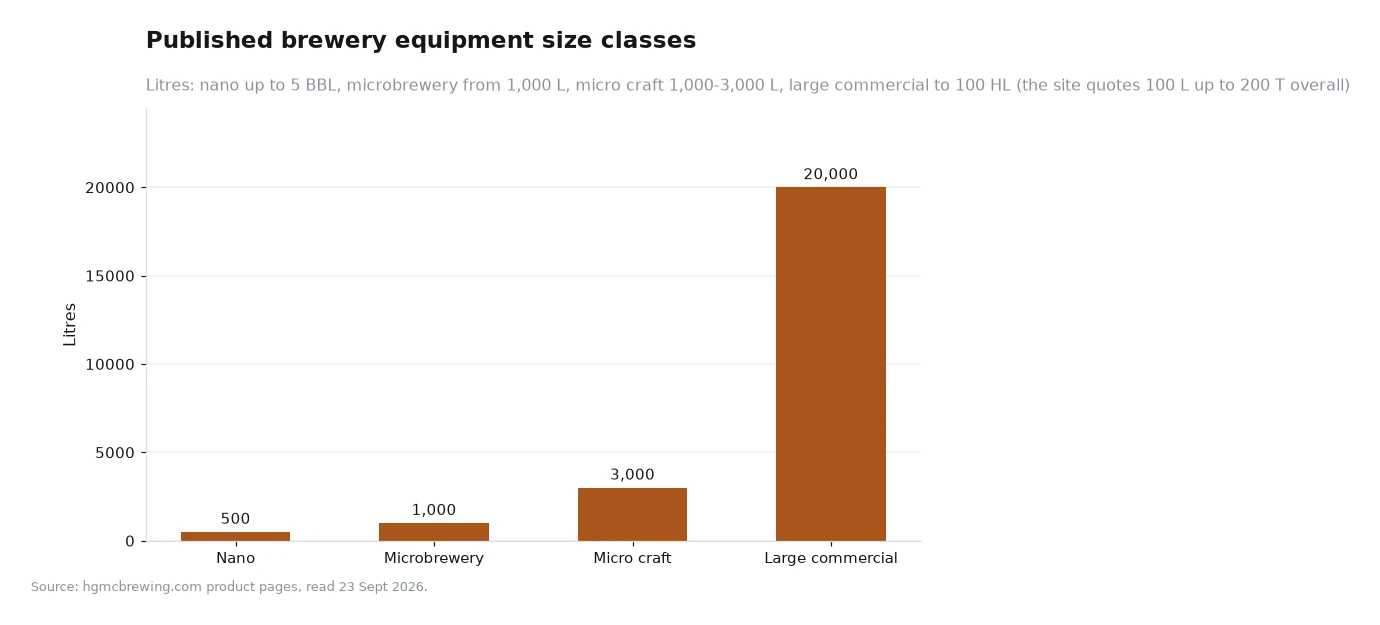
Scale check with the published classes: a 1,000 L brewhouse sits at the microbrewery floor in the published ladder, the 3,000 L ceiling of the micro craft band is three times the brew length, and the 20,000 L large commercial bar on the chart below is twenty times a single 1,000 L turn (20,000 / 1,000 = 20). A three-product plant is a scheduling problem at 1,000 L and a staffing problem at 20,000 L.
Frequently asked questions
Can the same tanks be used for beer, cider and kombucha?
Mechanically, often yes: the published range lists fermentation tanks for beer, kombucha, cider, conical and wine duties, built from the same food-grade stainless. In practice most producers keep kombucha on a dedicated set, because the acetic culture will find anything a cleaning cycle misses, and cider is usually kept to its own tanks simply because it occupies them for longer.
How much brewhouse time does a second product line take?
Budget a full cleaning cycle at every product change. In a worked plan of three beer brews, one cider brew and one kombucha brew a week, five brews at six hours plus two 2.5-hour changeovers comes to 35 hours of a 40-hour week, which leaves very little room for maintenance or a long batch.
Plan the Calendar Before the Catalogue
Write the fermentation calendar first, in days per product, and let it dictate the tank count. A brewery that buys tanks from a beer-only plan and then adds cider will discover that the constraint is not the kettle and not the capital, but the floor space between the tanks.
The brewery-system pages set out the published delivery window of 90-150 days from deposit to door delivery, the micro craft pages cover the band a three-product plant usually starts in, and the main site carries the full product family list from 100 L to 200 T.
Then order in phases if the room is tight: the shared brewhouse and CIP first, the beer tanks second, the cider and kombucha tanks when the first two are selling. HGMC has shipped to more than 120 countries and provides free 3D layout design, so the second phase can be drawn into the first plan before the first crate is opened.
Published figures here come from the manufacturer's own website (hgmcbrewing.com), read 23 Sept 2026: the product families covering beer, wine and cider and kombucha, the fermentation tank list, the capacity range from 100 L to 200 T, the size classes, the CIP and packaging equipment, the 90-150 day delivery window and the 6-year warranty on tank accessories and electronic components against manufacturing defects. Tank counts, residencies and hours are the author's own labelled assumptions.[1]